
Osaka
Japan's Spirited Heart and Trending Global Destination
Bold, delicious, and unmistakably alive — Osaka is the city that feeds your soul and dazzles your senses like nowhere else on earth.
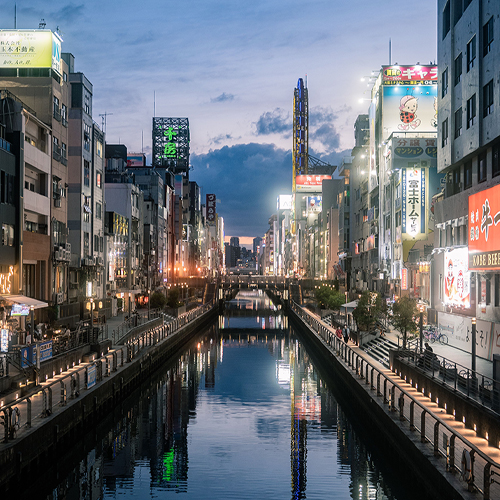
The World's #1 Trending Destination
Osaka hasn’t just climbed the travel charts — it has rocketed to the very top. Named the single most trending destination on the globe, the city earned its crown based on the largest year-on-year surge in traveler reviews of any city worldwide. That’s not a fluke; it’s a phenomenon. Millions of visitors are discovering what those in the know have long understood: Osaka is a place of pure, unfiltered energy.
Where Tokyo dazzles with its precision and polish, Osaka captivates with something rarer — its raw, beating personality. Locals describe their hometown with pride using three words that have become something of a civic mantra: playful, gaudy, and unpretentious. There is no performance here, no curated cool designed for outside consumption. What you see is what you get, and what you get is extraordinary. Street vendors banter with customers, restaurants compete with increasingly theatrical signage, and strangers will happily redirect your map before you even finish asking.
Travel writers and trend analysts alike have struggled to fully explain Osaka’s sudden moment in the global spotlight, but seasoned visitors understand it intuitively. In a world increasingly exhausted by over-touristed landmarks and Instagram-engineered experiences, Osaka offers something genuinely different: a city that lives loudly for itself, and invites you to live loudly alongside it. The numbers are simply catching up with the reality that adventurous travelers have been quietly sharing for years.
#1
Global Ranking
Top trending destination worldwide based on traveler review growth
19M
Annual Visitors
International tourists flocking to Osaka each year
3
Kansai Gems
Kyoto, Nara, and Kobe all within 30–60 minutes by rail.
Tenka no Daidokoro: The Nation's Kitchen
Long before Osaka became a global travel sensation, it earned a title among its own people that says everything: Tenka no Daidokoro, or “The Nation’s Kitchen.” This isn’t merely a charming nickname — it’s a historical designation rooted in the Edo period, when Osaka served as the primary hub of Japan’s rice trade. Merchants, farmers, and distributors funneled the country’s most essential commodity through this city’s markets and waterways, making Osaka the literal and symbolic center of Japanese sustenance for centuries. That legacy never left.
Kuidaore Philosophy
The word Kuidaore — loosely translated as “eat until you drop” or “ruin yourself through eating” — is not a warning in Osaka. It is a lifestyle, a cultural value, and a point of civic pride. Locals don’t just enjoy food; they organize their lives around it. Neighborhoods are compared by their restaurant density, conversations begin and end with meal recommendations, and the measure of a good day often comes down to what was eaten.
Culinary Icons Born Here
Takoyaki — golden, crispy octopus-filled dough balls topped with bonito flakes, mayo, and savory sauce — originated in Osaka in the 1930s and remain the city’s most iconic street food. Okonomiyaki, the hearty savory pancake loaded with cabbage, meat, and seafood, is another Osakan invention that has spread across Japan but tastes best at its source. Kushikatsu, deep-fried skewered meats and vegetables, rounds out the holy trinity of Osakan comfort food.
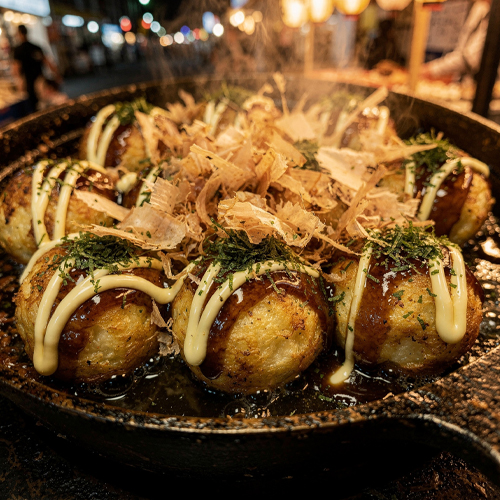
Takoyaki
Osaka’s most beloved street snack — crispy golden balls filled with tender octopus, drizzled with savory sauce and dancing bonito flakes.
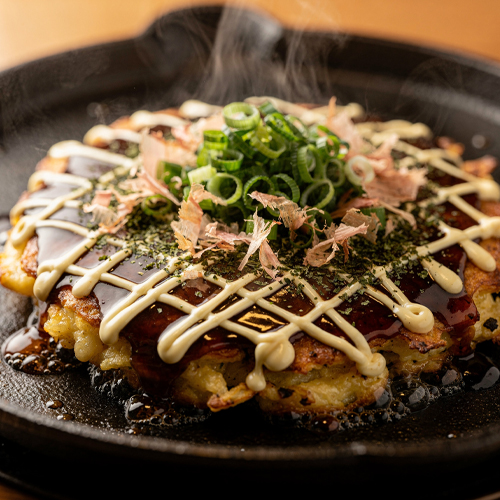
Okonomiyaki
The ultimate comfort food — a thick, satisfying savory pancake loaded with cabbage, seafood, and meat, griddled fresh to order.
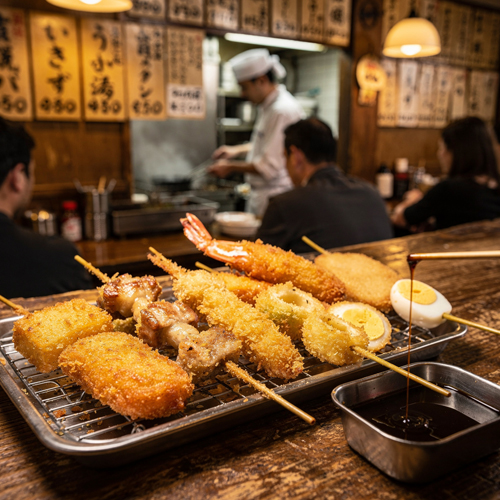
Kushikatsu
— a cornerstone of Osaka’s standing-bar culture.
Dotonbori: The Neon Pulse
If Osaka is Japan’s most spirited city, then Dotonbori is its loudest, brightest, most deliriously alive neighborhood. Stretching along the canal that bears the same name, this district is where the city’s personality reaches its most concentrated and theatrical form. The iconic Glico Running Man — that triumphant illuminated sprinter who has presided over the canal since 1935 — greets you like a mascot of the city’s eternal optimism, his neon glow shimmering in the black water below. Standing on Ebisubashi Bridge watching that reflection is one of travel’s genuinely iconic moments.
But Dotonbori is far more than a photo opportunity. It is a sensory experience engineered to overwhelm in the best possible way. Three-dimensional restaurant signs jut out over the street — giant mechanical crabs snap their claws, enormous fish leap from storefronts, and blowfish dangle from facades. Every establishment competes for your attention with baroque enthusiasm. The street-level food stalls run continuously, offering fresh takoyaki, skewered meats, crepes, ramen, and every conceivable variation of fried dough at prices that feel almost implausibly reasonable.
The best way to experience Dotonbori is not to plan it — it is to surrender to it. Begin at Namba Station as evening falls and simply walk northward toward the canal, letting the crowds, the smells, and the noise carry you. Stop when something looks good. Eat standing up. Double back. There is no wrong direction, no missed attraction serious enough to warrant anxiety. Dotonbori rewards presence and spontaneity above all else, and the tourists who linger longest are inevitably those who abandoned their itineraries at the canal’s edge.
Historical Anchors
For all its neon exuberance and culinary theatre, Osaka carries genuine historical weight. The city has been a seat of political power, a commercial hub, and a cultural crucible for over a millennium, and traces of that layered past are woven into its modern fabric for those willing to look. Three sites in particular serve as essential counterpoints to Dotonbori’s sensory overload — quieter, more contemplative experiences that reveal the deeper dimensions of a city too often reduced to its street food alone.
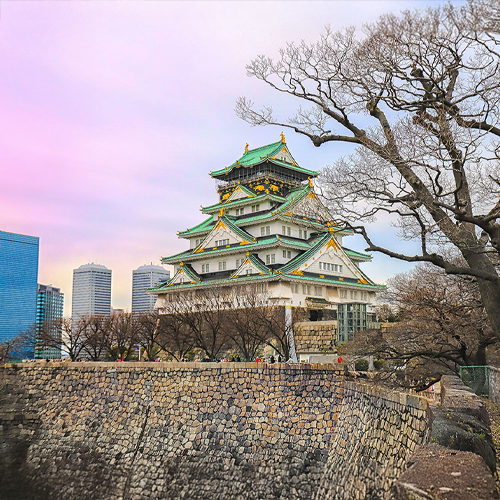
Osaka Castle
Few structures in Japan command a landscape quite like Osaka Castle. Originally built by the warlord Toyotomi Hideyoshi in the 1580s as a symbol of his unification of Japan, the castle has been destroyed, rebuilt, and restored across four centuries of turbulent history. Today it rises majestically above a vast moat and stone walls, surrounded by parkland that becomes one of Japan’s most celebrated hanami (cherry blossom viewing) destinations each April. The castle’s interior functions as an excellent history museum, tracing Osaka’s political and military significance through artifacts, armor, and immersive dioramas. Climb to the eighth-floor observation deck for sweeping views of the modern city that has grown up around this ancient symbol of power.
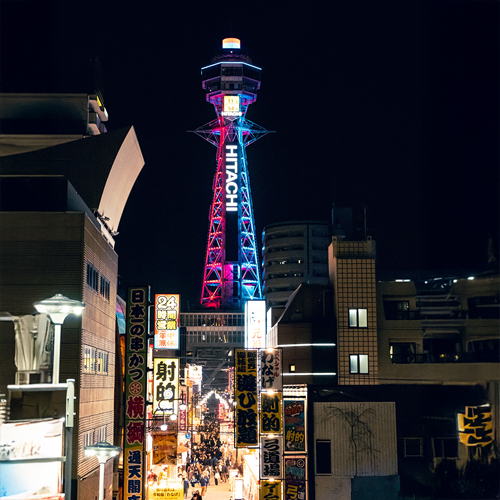
Tsutenkaku Tower
Standing in the retro neighborhood of Shinsekai — literally “New World,” a district built in 1912 to evoke Paris and New York simultaneously — Tsutenkaku Tower is Osaka’s most endearing landmark. Built in 1912 and rebuilt in 1956, the tower is modest by modern standards but enormous in cultural significance, serving as the symbolic heart of a working-class neighborhood that has resisted gentrification and retained its authentic, slightly faded charm. The surrounding streets are lined with kushikatsu restaurants, pachinko parlors, and shogi-playing retirees. Visiting Shinsekai and its tower offers a rare window into an Osaka that predates both the bubble economy and the tourism boom — honest, warm, and utterly itself.
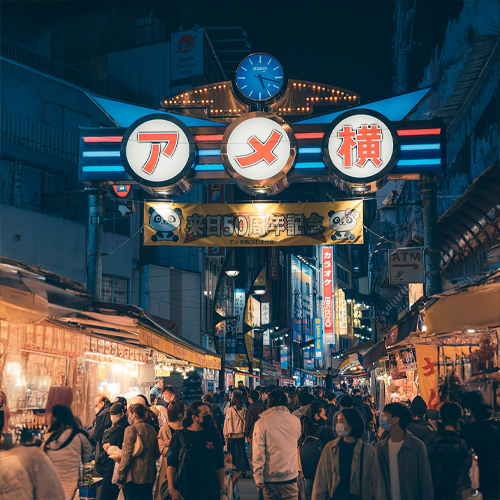
Hozenji Yokocho
Tucked behind the din of Dotonbori, Hozenji Yokocho is one of Osaka’s most quietly magical spaces. This narrow stone-paved alleyway, barely wide enough for two people to pass comfortably, is lined with small traditional restaurants and bars that have served the same neighborhood for generations. At its center stands the moss-covered Fudo Myo-o statue at Hozenji Temple — blanketed in green from the water offerings of millions of worshippers over decades. Visiting at night, when lanterns cast a warm amber glow over the wet stones and the smell of grilling food drifts from open doorways, is to experience Osaka at its most quietly profound. It is the city’s soul, rendered in stone and light.
Modern Wonders and Family Fun
For all its neon exuberance and culinary theatre, Osaka carries genuine historical weight. The city has been a seat of political power, a commercial hub, and a cultural crucible for over a millennium, and traces of that layered past are woven into its modern fabric for those willing to look. Three sites in particular serve as essential counterpoints to Dotonbori’s sensory overload — quieter, more contemplative experiences that reveal the deeper dimensions of a city too often reduced to its street food alone.
Universal Studios Japan
Universal Studios Japan in Osaka has evolved far beyond its Hollywood origins to become one of Asia’s premier theme park destinations. The crown jewel is Super Nintendo World — a fully realized, breathtakingly detailed immersive environment that feels less like a theme park attraction and more like stepping inside a living video game. Visitors wear wristbands that interact with the environment, collect virtual coins, and battle bosses in augmented reality. The Wizarding World of Harry Potter remains consistently world-class, with Hogsmeade rendered with extraordinary attention to detail. Lines are long but queues are well-managed, and the overall experience justifies the investment for visitors of any age.
Abeno Harukas & Kaiyukan
For those seeking altitude, Abeno Harukas rises 300 meters above southern Osaka as one of Japan’s tallest skyscrapers, offering a 360-degree observation deck that on clear days stretches all the way to Kyoto and beyond. The building itself integrates a department store, hotel, and art museum — a vertical city within the city. In the Bay Area, the Osaka Aquarium Kaiyukan ranks consistently among the world’s finest marine facilities. Its centerpiece is a vast central tank housing whale sharks — the world’s largest fish — alongside manta rays and thousands of other species. The spiral walkthrough design allows visitors to descend through multiple ocean ecosystems in a single seamless journey.
The Warmest Welcome in Japan
Japan is globally celebrated for its hospitality — a culture of gracious service and impeccable manners that leaves virtually every visitor feeling welcomed and respected. But Osaka’s warmth operates on a different register entirely. Where other Japanese cities express hospitality through refined formality, Osaka expresses it through something rarer and more immediately disarming: genuine human warmth, humor, and directness.
Direct & Funny Locals
Osakans are famous throughout Japan for their wit. The city has produced a disproportionate number of Japan’s most beloved comedians, and that comedic sensibility permeates daily life. Shopkeepers crack jokes across the counter, taxi drivers offer unsolicited but genuinely useful opinions, and casual encounters have a warmth and ease that can feel startlingly different to visitors accustomed to more formal Japanese interactions. Being laughed with — not at — is a common and charming Osakan social currency.
Strangers Who Walk You There
A frequently repeated — and entirely accurate — piece of Osaka travel lore is that if you ask a local for directions, they are as likely to walk you to your destination as they are to simply point you in the right direction. This isn’t an exaggeration for effect; it reflects a deeply embedded social culture of practical generosity. Osakans don’t just tell you where to go — they take you there, often going considerably out of their own way to do so, and refusing any thanks with a dismissive wave and a grin.
Ideal for First-Time Japan Visitors
For travelers making their first trip to Japan, the country’s cultural protocols — however beautiful — can feel daunting. Osaka provides the gentlest possible entry point. The city’s social looseness, its tolerance for minor missteps, its sheer enthusiasm for feeding and entertaining visitors, and its reputation for approachable locals all combine to create an environment where first-time visitors feel not just tolerated but genuinely celebrated. Osaka doesn’t want you to observe it from a careful distance — it wants to pull you into the fun.
The Perfect Kansai Hub
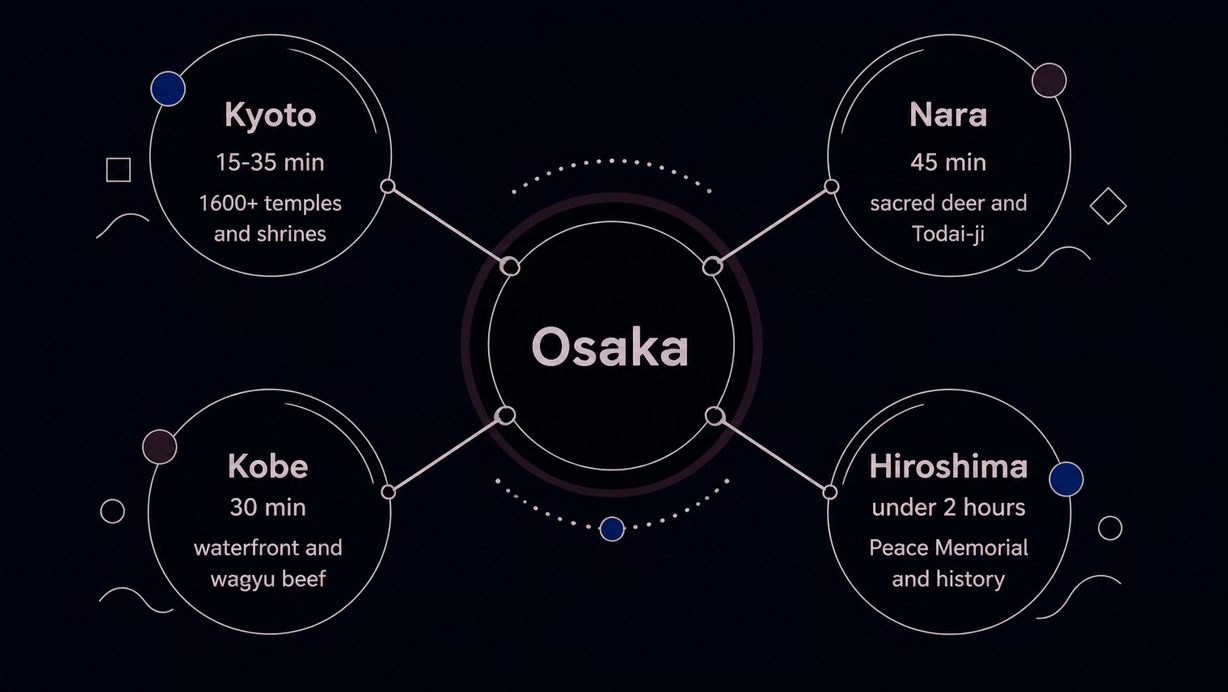
One of Osaka’s most strategically compelling qualities for the international traveler is its geography. Positioned at the center of Japan’s historic Kansai region, Osaka sits within effortless reach of some of the country’s most celebrated destinations — making it not just a destination in its own right, but an extraordinarily efficient base for regional exploration. Choosing Osaka as your home city doesn’t mean choosing between urban energy and cultural depth; it means having access to both, simultaneously, without compromise.
The numbers speak for themselves. Kyoto, Japan’s ancient imperial capital and home to over 1,600 Buddhist temples and Shinto shrines, is just 15 minutes away by Shinkansen — or 35 minutes by the affordable and frequent Hankyu or JR lines. Nara, where hundreds of freely roaming sacred deer share space with monumental Buddhist statuary including the awe-inspiring Todai-ji temple, is a straightforward 45-minute journey by express train. Kobe, with its cosmopolitan waterfront, world-famous beef, and distinctive blend of Japanese and Western architectural heritage, lies just 30 minutes to the west. For those with more time and adventu
Essential Logistics
Getting to Osaka, settling in, and navigating the city are all considerably more straightforward than nervous first-time Japan visitors might fear. The city’s infrastructure is world-class, its signage is multilingual, and its residents are genuinely eager to help when systems fall short. With a little advance preparation, the practical elements of an Osaka trip handle themselves — leaving you free to focus on the extraordinary experiences waiting at every turn.
Arriving via KIX
Kansai International Airport (KIX) is Osaka’s primary international gateway, offering direct connections from major hubs across North America, Europe, Southeast Asia, and beyond. The airport sits on an artificial island in Osaka Bay and connects to the city center via the efficient Haruka Express train (75 minutes to Osaka Station, 50 minutes to Tennoji) or the faster and less expensive Airport Limousine Bus. The Nankai Rapi:t train offers the most direct connection to Namba in approximately 38 minutes. Pre-purchasing an IC card (ICOCA or Suica) before leaving the airport will make every subsequent transit interaction seamlessly frictionless.
Where to Stay
The neighborhood you choose as your base will meaningfully shape your Osaka experience. Namba and Dotonbori place you in the absolute center of the action — restaurants, nightlife, and major attractions are walkable from virtually any hotel. It is loud, bright, and thrilling, ideal for those who want to be fully immersed. Umeda, in the city’s north, offers a more polished environment centered around excellent transit connections, Osaka’s finest department stores, and a more diverse international dining scene. It is the better choice for those using Osaka primarily as a regional base, or those who prefer a calmer return to their room after long days of exploration.
Embrace Spontaneity
The single most important logistical advice for an Osaka trip is to resist the urge to over-schedule it. The city’s greatest pleasures are largely unplannable — the hole-in-the-wall ramen counter you notice mid-walk, the takoyaki vendor who waves you over from across the street, the traditional shotengai (covered shopping arcade) you wander into by accident and emerge from an hour later with a bag full of snacks. Build a skeleton of must-see sites if it settles your nerves, but leave generous margins of unallocated time in every day. In Osaka, those gaps are where the real memories are made.
Your Osaka Adventure Awaits
Osaka is not a city that asks you to appreciate it from a respectful distance. It grabs you by the sleeve, points to something delicious, makes you laugh, and insists you try one more thing before you go. It is a city that operates at full volume, in full color, with absolute conviction — and that energy is contagious in the best possible way. Whether you are a first-time visitor to Japan or a seasoned Asia traveler adding another chapter, Osaka offers an experience that is simultaneously accessible and deeply rewarding.
The range of experiences on offer is genuinely staggering. Michelin-starred restaurants — Osaka has one of the highest concentrations of Michelin-starred establishments of any city on earth — sit within walking distance of street stalls where extraordinary takoyaki costs less than a coffee back home. Ancient castle grounds that evoke centuries of Japanese history are twenty minutes by metro from a theme park experience that represents the future of entertainment. Atmospheric temple alleyways where moss-covered statues receive offerings by candlelight exist in the same city as observation decks surveying a 21st-century megalopolis in every direction.
The world has noticed what those who love Osaka have always known — and now is the moment to experience it before it becomes the thing everyone says they should have seen earlier. The cherry blossoms of April, the summer festivals of July and August, the perfect clarity of autumn, and the illuminated winter gardens all offer their own compelling reasons to visit. Every season in Osaka is a good season. Every visit is too short. And virtually every traveler who arrives leaves already thinking about when to return.
Start Planning Today
Millions of travelers have already discovered Osaka’s irresistible charm. The city’s combination of world-class food, genuine warmth, extraordinary history, and effortless regional connectivity makes it one of the most complete travel experiences on earth — at a price point that continues to surprise and delight.
Why Osaka Wins
- Authentic and affordable — world-class experiences at accessible prices
- Incredibly welcoming — the friendliest locals in Japan
- Endlessly delicious — the nation’s kitchen lives up to every word of its title
- Strategically located — the ideal base for all of Kansai’s wonders
- Unforgettable — a city that stays with you long aft